
Climate change vulnerability assessment of culturally important plants and ecosystems
How will climate change affect the plants and natural resources that are culturally and economically important to the Port Gamble S’Klallam Tribe and the Suquamish Tribe? Are there opportunities to improve the resilience of these ecosystems?
In this project, we will conduct a region-wide climate change vulnerability assessment through a novel collaboration between Great Peninsula Conservancy, the Port Gamble S’Klallam Tribe, the Suquamish Tribe, and Haven Ecology and Research LLC.
As a sector-based assessment focused on natural resources, this project will involve a quantitative spatial analysis of multiple factors that can influence the exposure and vulnerability of an ecosystem to climate change, including soil type, topography, hydrology, and species composition.
The goals of this project are three-fold:
- Evaluate the climate change vulnerability of natural resources that are culturally important to Coast Salish Tribal communities, specifically the exposure, sensitivity and adaptive capacity of inland ecosystems such as forests, riparian corridors, and freshwater wetlands.
- Identify potential refugia for sensitive plant species.
- Build capacity for greater collaboration between local governments, Tribal governments and community-based organizations to implement climate change adaptation strategies.
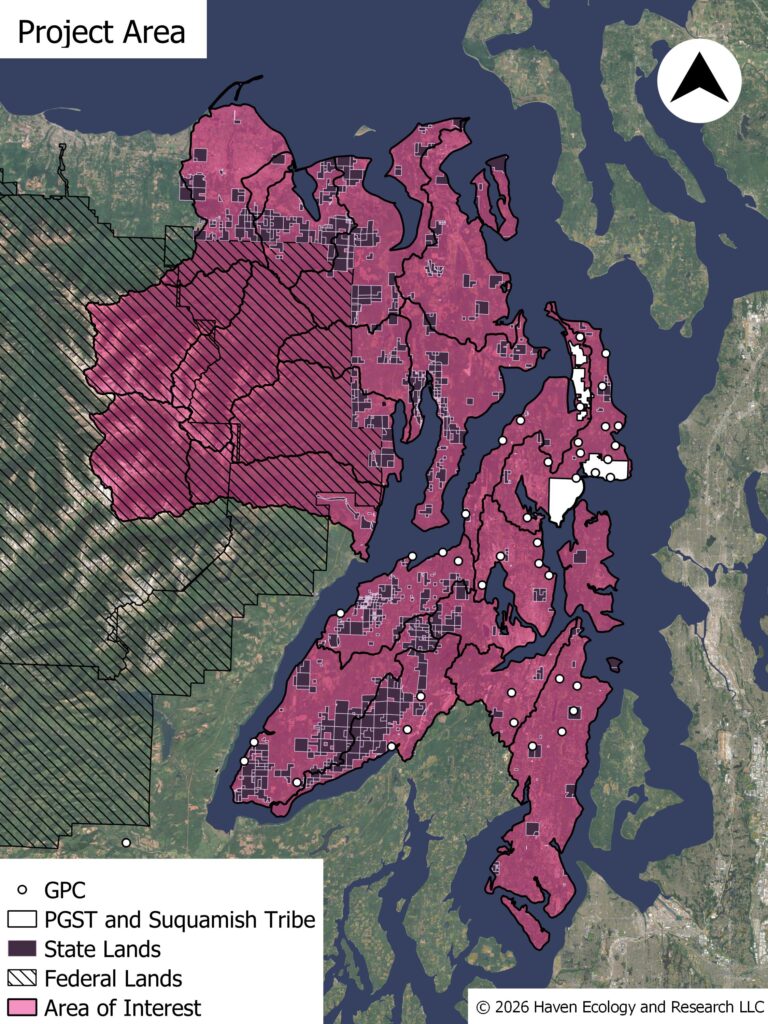
Located in Western Washington, the project area encompasses the NE region of the Olympic Peninsula and most of the Kitsap Peninsula, including watersheds that contain high priority public and private lands with the greatest potential for long-term stewardship.
Although primarily focused on spatial analysis, this assessment will be strongly informed by qualitative information from community stakeholders to identify places, plant species and other natural resources that are important community assets. We will also conduct field-based rapid assessments to ground-truth the analysis based on local site conditions.